

WORKERS Baker Pants, Trace MIL-838-D
¥20,900 (tax incl.) · In stock
- Size
- S / M
- Color
- Reversed-Sateen/OD-Herringbone
Stock changes daily. To check before visiting, send us a message on Instagram or call us.
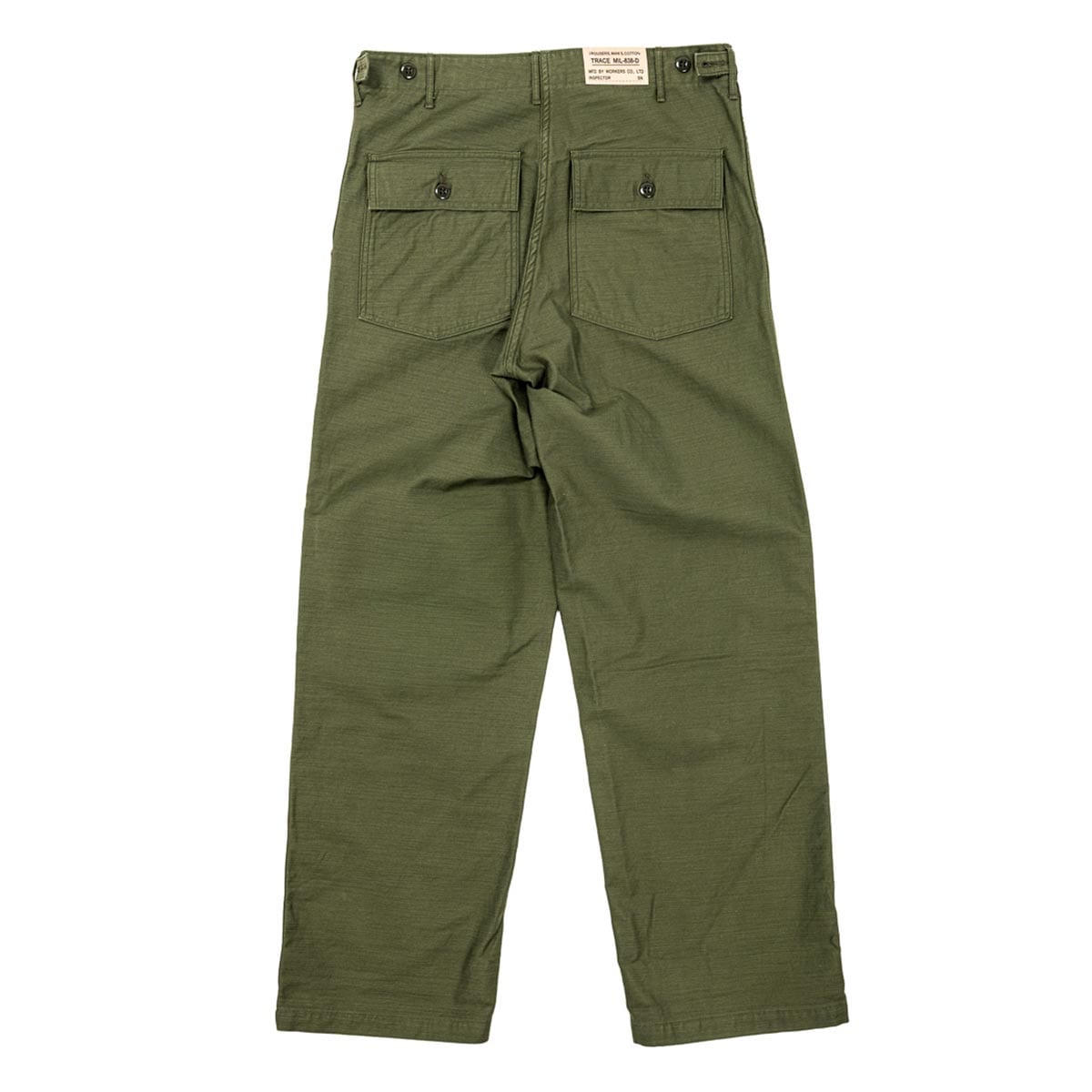
WORKERS Baker Pants, Trace MIL-838-D (2610-BP-MIL838). MADE IN JAPAN.
The official name is TROUSERS, MEN’S, COTTON, SATEEN, commonly known as baker pants. The pattern is created by tracing an original pair of MIL-T-838D (1958) trousers. It features a loose silhouette with a 24 cm hem width, wide thighs, and a deep rise. It is a versatile pant for year-round wear, allowing airflow in summer and comfortably accommodating leggings in winter.
Reversed-Sateen: When people think of baker pants, they think of back sateen. This fabric was developed based on original MIL-T-838D and MIL-C-10296J specifications, featuring the coarse texture typical of baker pants. Compared to herringbone, the yarn is thicker and the thread count is lower, resulting in a supple and soft feel.
While early versions used sulfur dyeing, this version uses vat dyeing. Vat dyeing is more colorfast than sulfur dyeing, but areas subject to friction will fade to white, creating a high-contrast aging effect. Unlike sulfur dyeing, which fades uniformly, vat dyeing creates a distinct difference between high-friction and low-friction areas.
OD-Herringbone: We have also prepared an OD herringbone version for those who already own back sateen baker pants. It pairs perfectly with the loose silhouette. It is slightly lighter and thinner than the back sateen. The yarn is finer, and the tighter weave gives it a firmer, more structured feel. Even with the same cotton material, differences in yarn thickness, thread count, and weave structure significantly change the texture and feel.
Products are one-washed (OW).